

Safety and precision are of utmost importance in any scientific laboratory, whether it is academic, research –based, pharmaceutical or industrial.
Choosing the right laboratory dispensing equipment is important for maintaining accuracy, avoiding contamination and ensuring desired results.
Amongst the most commonly used tools are wash bottles, pipettes and droppers. Let us understand when to use these tools, their benefits and limitations, so you can make the right decision in your lab workflow.
What is a Wash Bottle?
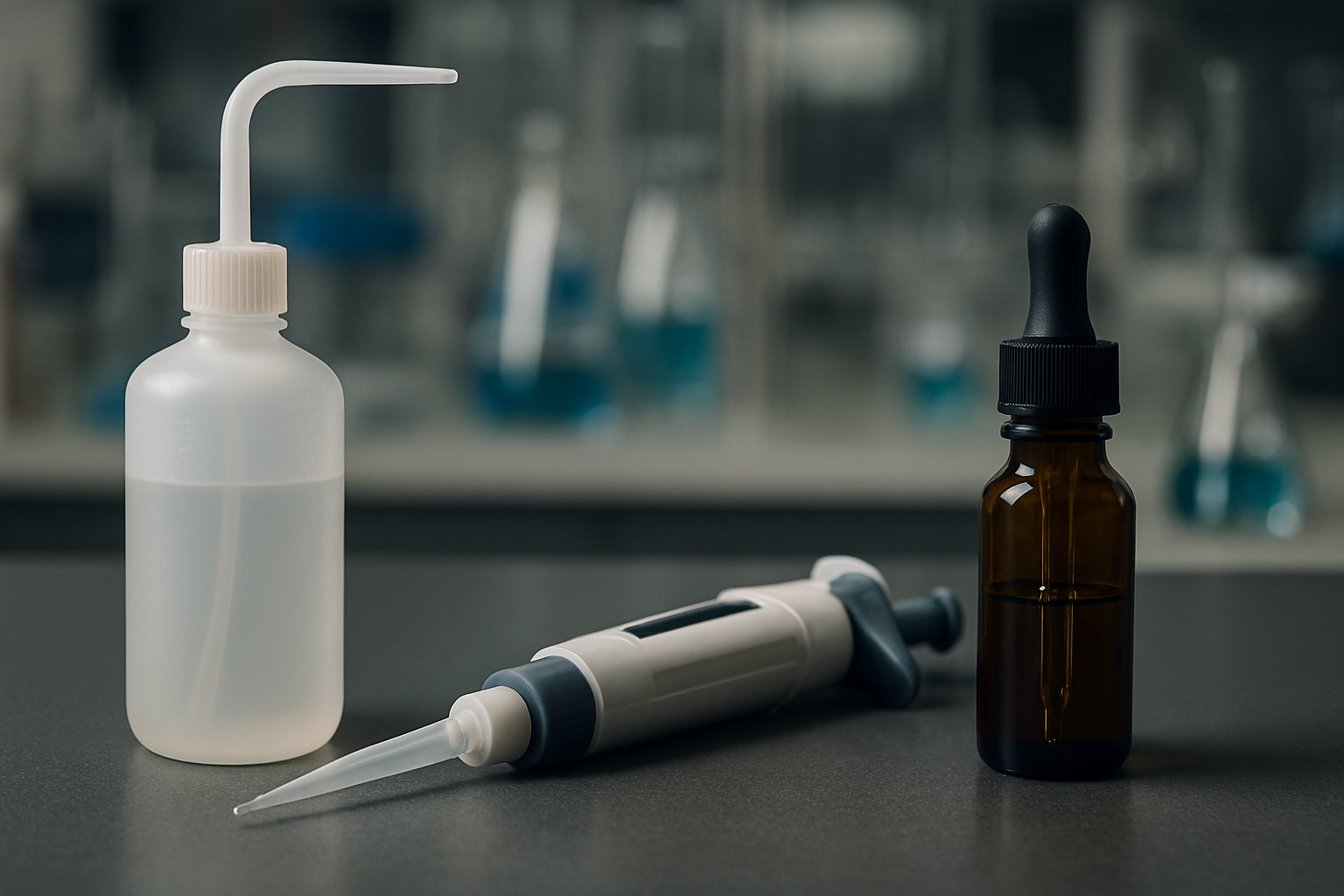
It is a squeezable plastic bottle, typically made from low-density polyethene. They are used to dispense liquids in a controlled stream. The bottle is filled with distilled water, deionized water, ethanol or other rinsing solvents.
What are the uses of Wash Bottles in a Lab?
- They are widely used for rinsing glassware like flasks, beakers and test tubes.
- They are used for washing precipitates during filtration
- To clean electrode probes or pH meters
- To dispense small amounts of solvent for cleaning.
Why choose a wash bottle?
If you do not need an accurate measurement, these bottles are used in the lab. Their main purpose is cleaning, rinsing or transferring non-measured liquid volumes.
What are the Limitations of Wash Bottles?
- If accurate volume measurement is required, they are not suitable
- The flow rate depends on the squeeze pressure
- It is not recommended for highly harmful chemicals.
What are Pipettes?
They are an ideal tool for accurate liquid handling. It is a lab instrument designed to measure and transfer an accurate volume of liquid. They are used in chemistry, biology, biotechnology and medical laboratories.
What are the uses of Pipettes?
- To prepare chemical solutions
- To perform titrations
- For molecular biology experiments
- Quality control testing
- Pharmaceutical Formulation
Importance of Pipettes
- High Accuracy and Reproducibility
- Adjustable volume settings
- Versatile for various applications
Benefits of Pipettes
- High precision and accuracy
- Repeatable results
- Apt for critical experimental work
Disadvantages of Pipettes
- Requires maintenance and calibration
- Can be expensive
- Needs trained handling to avoid contamination
What is a Dropper?
A dropper is a simple liquid transfer tool with a small tube and a rubber bulb. It dispenses liquid in drops rather than measured units.
What are the uses of Dropper?
Droppers are used in-
- Basic chemical labs
- Educational institutions
- Medical or diagnostic testing kits
- Adding indicators during titration
When to use Dropper?
Droppers are used –
- To add reagents drop-wise
- To mix small quantities of chemicals
- For a simple lab demonstration
- Non-precision testing
What are the benefits of Dropper?
- They are easy to use
- They are of low cost
- They are good for drop-wise addition
What are the limitations of Dropper?
- Accurate measurement is not possible
- Drop size varies
- Not suitable for high-precision applications.
Pipette v/s Dropper in the Laboratory.
- Purpose: A pipette is used for measuring and transferring an exact volume of liquid in a lab experiment. A dropper is used for adding liquid drop by drop without precise measurement.
- Accuracy: The pipette is highly accurate and calibrated for specific volumes. Dropper is not accurate; drop size may vary depending on pressure and liquid type.
- Volume Control: The pipette comes with fixed or adjustable volume settings for controlled dispensing. There are no volume markings on the dropper. The liquid is dispensed based on bulb pressure.
- Common Applications: Pipette is used for chemical analysis, microbiology, PCR testing, pharmaceutical labs and research work. The dropper is used in basic chemistry labs, demonstrations, adding indicators or simple reagent mixing.
- Cost: The pipette is expensive due to its accurate mechanism. Dropper is economical and often disposable.
- Maintenance: Pipette required regular calibration and careful handling. Dropper needs minimal maintenance and is often replaced after use.
Difference between a wash bottle v/s pipettes
- Purpose: A wash bottle is used mainly for rinsing glassware and cleaning lab tools. A pipette is used for accurately measuring and transferring specific volumes of liquid.
- Accuracy: The wash bottle does not provide an accurate measurement. A pipette is very accurate and calibrated for precise volume measurement.
- Volume Control: The wash bottle dispenses liquid in a continuous stream without volume markings. Pipette is designed with fixed or adjustable volume settings for controlled dispensing.
- Application Area: The wash bottle is ideal for washing precipitates, rinsing burettes or adding distilled water. A pipette is commonly used in chemical analysis, microbiology, pharmaceutical testing and research experiments.
- Construction: The wash bottle is made of plastic with a narrow nozzle. A pipette can be glass or plastic.
- Cost: The wash bottle cost is low and can be easily replaced. A pipette is more expensive due to its precision features and calibration.
- Maintenance: The pipette requires regular calibration and proper handling. The wash bottle is easy to maintain and requires basic cleaning.
Water Bottle v/s Dropper
- Purpose: A water bottle is used for rinsing glassware, washing precipitates or dispensing distilled water in labs. A dropper is used for adding small amounts of liquid drop by drop.
- Dispensing style: Water bottle releases liquid in a continuous stream when squeezed. Dropper dispenses liquid in individual drops.
- Accuracy: The water bottle is not meant for measurement as there is no volume control. Dropper is slightly better than a wash bottle, but still not precise or calibrated.
- Design: The water bottle is of a plastic body with an angled nozzle. Dropper is made of glass or plastic tube with a rubber bulb.
- Cost and Maintenance: The cost is low and they are easy to refill and can be reused. Dropper cost is also low. They are easy to clean and are disposable.
The lab liquid dispensing tools comparison will help scientists, lab technicians and quality control experts maintain accuracy, safety and operational efficiency.
FAQs
- Can a dropper replace a pipette?
It is advisable to understand the difference between a pipette and a dropper. A dropper cannot replace a pipette as they are not accurate. United Poly supplies the best quality droppers and pipettes for your use. - Are wash bottles safe for chemicals?
Yes, they are safe only for non-reactive and compatible chemicals. - What is the difference between wash bottle and a pipette?
A wash bottle is used for rinsing and dispensing liquids without measurements, while a pipette is designed to accurately measure and transfer specific volumes of liquid in lab. United Poly offers premium-quality and medical-grade wash bottles and pipettes aligned with your needs.
About the Author
United Poly is a trusted manufacturer and supplier of the best quality hospital and laboratory equipment. They cater to the needs of hospitals, diagnostic labs, research centers, and medical colleges.
Their products, such as droppers, wash bottles, pipettes, stainless steel furniture, trolleys, hospital beds and more are designed to ensure safety, hygiene, operational efficiency and durability.